A one-in-a-million catch in a New York harbor turns out to be a bright yellow burbotAdrian Villellas Sat, November 21, 2026 at 1:37 PM UTC
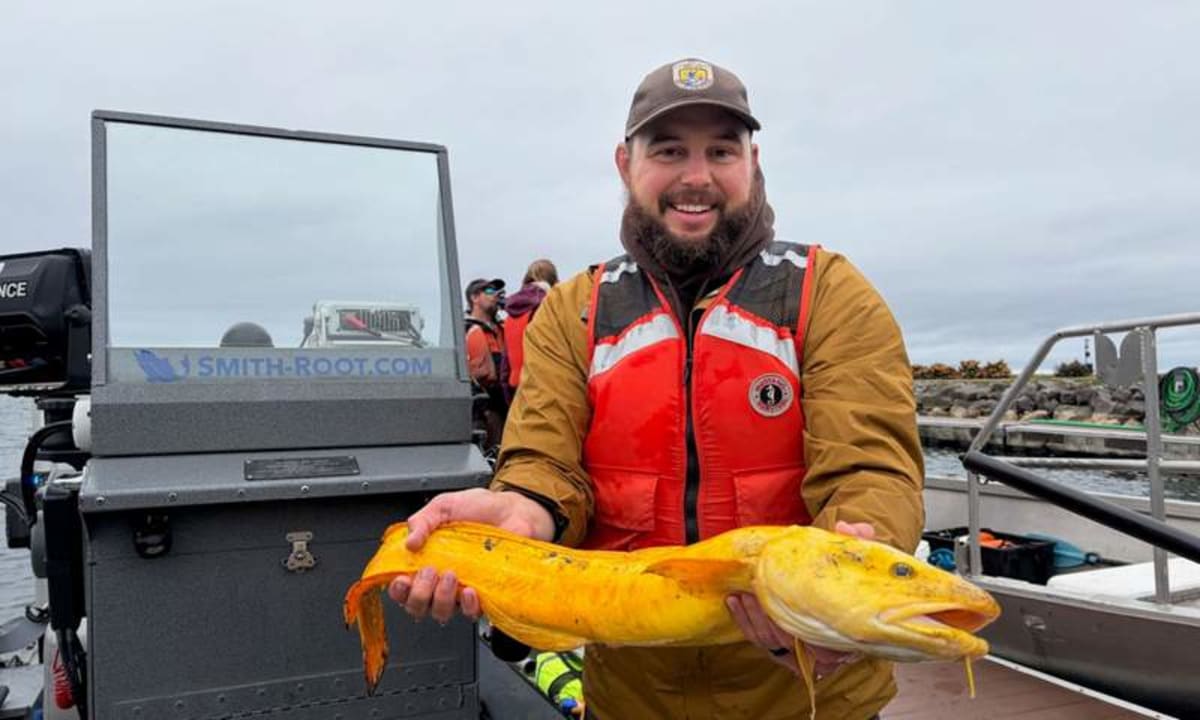
A member of the survey crew holds the rare yellow burbot caught during an invasive species survey in Oswego Harbor, New York. Credit: B. Weidel / USGS
Biologists with the U.S. Fish and Wildlife Service were running a routine survey in Oswego Harbor, New York, on Lake Ontario, in October when they pulled up a fish they did not expect. It was a burbot, and it was bright yellow-orange.
The agency calls it a one-in-a-million catch. The fish has xanthochromism, a rare condition that gives it a saturated yellow-orange color.
The agency said the fish would make even the brightest fall foliage look pale in comparison.
It is also the first burbot ever documented during a fisheries survey in Oswego Harbor, although a few anglers have reported catching them there.
What makes it yellow
Xanthochromism is caused by a genetic mutation that suppresses normal pigmentation and produces the yellow-orange appearance.
It is considerably less common in wild fish than albinism or melanism, according to the Fish and Wildlife Service. Unusual colors like this have surprised scientists before, as with a bright orange shark.
The place was a surprise too. Burbot populations in the lake are extremely low, and the species usually lives in deeper, cooler water than what is found inside the harbor.
The burbot’s yellow-orange color comes from xanthochromism, a genetic condition that suppresses normal pigmentation. Credit: C. Keefer / USFWS Click image to enlarge.A crew looking for something else
The crew was not looking for burbot. It came from the Lower Great Lakes Fish and Wildlife Conservation Office, and it was carrying out an Aquatic Invasive Species survey.
The program watches harbors, rivers and bays of the Great Lakes for invasive species on a watchlist.
Because invaders are often rare when they first arrive, the crews use several methods at once, including electrofishing, fyke nets, gill nets and environmental DNA, or eDNA.
Invaders are an old problem in these waters: the Great Lakes have been under invasion from one species for 70 years.
Most fish caught in these surveys are native species. Catching a rare native fish suggests the program may also detect newly arriving invaders when their numbers are still very low.
The agency summed it up as an effective survey strategy, along with a bit of luck.
A predator of the lake bottom
The burbot is a native fish of the Great Lakes. It tends to live on the lake bottom, and it is the only cod-like fish species in freshwater, according to a New York Sea Grant fact sheet. The same fact sheet calls it a formidable predator.
In the Great Lakes, sea lamprey predation has been a common factor affecting burbot numbers.
A 2006 study led by U.S. Geological Survey scientists found that burbot abundance in eastern Lake Erie increased significantly between 1987 and 2003.
The researchers, writing in Transactions of the American Fisheries Society, attributed the apparent recovery to effective sea lamprey control.
The same study suggested that a relatively high density of alewives, a small plankton-eating fish, probably held burbot numbers down in Lakes Ontario and Michigan at the time.
A sick fish sent to Cornell
When U.S. Geological Survey fisheries biologists who know the species processed the yellow burbot, they noticed it was emaciated and looked to be in poor health.
Because of its condition, and because the reasons the species remains so scarce in the lake are still unexplained, the fish was sent to the Cornell University College of Veterinary Medicine for a health analysis. The agency has not reported the results.
The agency says the catch could turn out to be lucky for the species too.
The rare fish may offer valuable insight into the health of burbot populations across the basin, and that could help guide how they are managed.
The information was obtained from the U.S. Fish and Wildlife Service, a New York Sea Grant fact sheet and a U.S. Geological Survey study.
—–
Like what you read? Subscribe to our newsletter for engaging articles, exclusive content, and the latest updates.
Check us out on EarthSnap, a free app brought to you by Eric Ralls and Earth.com.
—–
Source: Nature



0 Comments