
Thepublic display of violence in Mexicofollowing theslaying of drug lordNemesio Rubén Oseguera Cervantes could continue for a few days or weeks given his stature within the Jalisco New Generation Cartel and the group's extraordinary military-style capabilities, veteran cartel watchers tell USA TODAY.
The cartel produced a similar nationwide show of force in 2015, even using a rocket propelled grenade to shoot down a Mexican army helicopter, after the Mexican military tried to capture Oseguera Cervantes, more commonly known as "El Mencho."
In 2019, the rival Sinaloa Cartel waged war on the Mexican government when it tried to arrest one of the sons of its leader, Joaquin "El Chapo" Guzman.
"If past is prologue, what we've seen is that there will be at least a week, maybe more, of these sort of violent reprisals by the cartels. And then things will turn inward," Anthony Placido, former head of intelligence for the U.S. Drug Enforcement Administration, told USA TODAY.
 After Mexican officials announced a powerful Mexican cartel leader was killed during a military operation on Sunday, several regions of the country are grappling with ongoing security risks and unrest.
Police officers secure the area where vehicles were set on fire by organized crime members to block a road following a military operation in which a government source said Mexican drug lord Nemesio Oseguera, commonly known as "El Mencho," was killed, in Zapopan, Mexico, Feb. 22, 2026." style="max-width:100%; height:auto; border-radius:6px; margin:10px 0;" loading="lazy" />


 Mexican Army personnel stand guard as passengers leave Guadalajara International Airport in Tlaquepaque, Jalisco State, Mexico, on Feb. 22, 2026." style="max-width:100%; height:auto; border-radius:6px; margin:10px 0;" loading="lazy" />


Photos show Mexico unrest after cartel leader 'El Mencho' killed
After Mexican officials announced apowerful Mexican cartel leaderwas killed during a military operation on Sunday, several regions of the country are grappling withongoing security risks and unrest.Police officers secure the area where vehicles were set on fire by organized crime members to block a road following a military operation in which a government source said Mexican drug lord Nemesio Oseguera, commonly known as "El Mencho," was killed, in Zapopan, Mexico, Feb. 22, 2026.
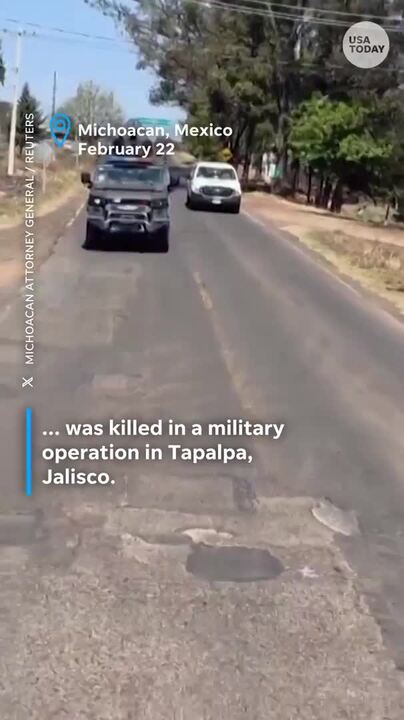
Already, criminal violence has engulfed parts of Mexico after troops killed Oseguera Cervantes in a Feb. 22 shootout in the cartel's stronghold in the western coastal state of Jalisco.
The cartel's response was immediate, spreading outward from Jalisco and plunging much of Mexico into chaos and violence. CJNG soldiers set cars, buses and businesses on fire and blockaded roads inviolence that spreadto 20 states. Mexican authorities said at least 62 people were killed, including 25 National Guard members, and 70 were arrested.
But as bad as things are in Mexico following Oseguera Cervantes' death, CJNG appears to have stopped short of unleashing anything close to the kind of violence it has shown it is capable of in the past.
U.S. counternarcotics officials have said in recent years the cartel has amassed so much firepower that it resembles more of asmall nation state's armythan a transnational crime syndicate.
The question now, experts say, is whether CJNG will de-escalate the sporadic violence and regroup, or ramp up its attacks on the Mexican government, the public and rival cartels fighting over the lucrative trafficking of cocaine, fentanyl, methamphetamine and other drugs into the United States.
Experts say the cartel will likely train its sophisticated arsenal of weapons on its rivals in an effort to get back to its main business − earning billions of dollars in annual drug revenue as what the U.S. Drug Enforcement Administration officially calls "one of thefive most dangerous criminal organizationsin the world."
'Nothing they do is going to bring Mencho back'
Most analysts say CJNG will regroup and focus on maintaining the global dominance over the drug trade that it has long shared with the rival Sinaloa cartel.
"Nothing they do is going to bring Mencho back," Placido said. "And so the most important thing for them is who's going to take over the cartel, and are the Sinaloa guys going to try and take their territory?"
"I don't have a crystal ball," Placido said. "But I would think that instead of these big public manifestations where they're burning vehicles and doing all kinds of stuff to protest against the government, they're going to rapidly become involved in sort of inter-cartel violence and warfare. And that will be more targeted."
In the short term, CNJG certainly has the capacity to wreak much more lethal violence on the Mexican government and the public – including American tourists who have been told to shelter in place.
Some past demonstrations of force by CJNG have included mass arson campaigns known as "narcobloqueos," even more simultaneous roadblocks across multiple states than it has currently – and high-profile assassination attempts.

A 'messy aftermath' before a cartel gets back to business
In an assessment Feb. 23, Mexico-based International Crisis Group analyst David Mora wrote that "claiming a top criminal scalp will not spare the government from a messy aftermath."
Vanda Felbab-Brown, a Brookings Institution expert on nonstate armed groups including CJNG, said the current violence echoes that which followed the Mexican government'sattempt to capture Ovidio Guzmán López, a son of El Chapo, in its stronghold of Culiacán in 2019.
Within hours, heavily armed Sinaloa forces paralyzed the city,directly assaulted the militaryand forced the government to release him.
In the current case, Felbab-Brown told USA TODAY, the current violence is essentially CJNG's way of showing its capabilities, essentially an act of "retaliatory, demonstrative violence against the state."
Advertisement
"They are saying, 'Hey Mexican government, we are punishing you. We are responding. You killed our leader. This is showing you what we can do,'" Felbab-Brown said.
"It's pretty enormous in geographic scope and scale," she said. "But it will die off in a matter of time."
That could take just a few days, or a few weeks, she said.
"And once this immediate violence settles, then the question is, what kind of other violence will break out within factions of CJNG and between them and their rivals?" Felbab-Brown said. "And that violence will be far more complicated and far more lasting."
What happened after El Chapo's capture
Once the initial explosion of publicly directed violence dies down, what happens next depends on a number of factors.
El Mencho left no clear heir, Mora said, and the remaining leaders could dispute control.
If CJNG doesn't quickly appoint a successor and close ranks, infighting among rival factions within it could consume the organization, Placido said.
That was the case after the capture of Joaquin "El Chapo" Guzman, the leader of the rival Sinaloa cartel a decade ago.
Since then, Sinaloa has been wracked by infighting and internal power struggles between the sons of "El Chapo" – known as the "Chapitos" – and factions loyal to Ismael "El Mayo" Zambada, who is now in U.S. custody too.
Much of that violence is cartel-on-cartel though, and would not paralyze huge swaths of Mexico – and its important tourist industry – like the current situation, Placido and Felbab-Brown said.
In the case of CJNG, taking out El Mencho could slow his own cartel's rapid expansion within Mexico and internationally. But it is also likely to leave it weakened against the Sinaloa cartel on several fronts that could lead to bloody turf battles throughout Mexico and even in the United States, they said.
A less likely but still possible scenario: all-out war
A less likely scenario is that CJNG will launch a longterm war against the Mexican government to avenge the death of its longtime leader.
Over the past half century, Mexican drug cartels and criminal gangs haveengaged in protracted skirmishesover its sporadic counternarcotics crackdowns. Colombian cartels did the same thing in the 1990s with car bombs, assassinations and attacks on the military.
If that happens, CNJG is capable of inflicting significant damage, given its arsenal of heavy weapons,many of them obtained from U.S. gun manufacturers,according to a USA TODAY investigation.
Most analysts predict that won't be the case because CJNG, like Sinaloa and other cartels before it, would prefer a détente with the government that allows it to focus on its global business operations.
"In many ways, it's just a waste of resources. El Mencho is dead, so there is nothing to bargain for" like there was after the arrest of El Chapo's son, Felbab-Brown said.
Some public violence is needed, she said, "to show how fearless they are, how they can act with more brazenness, more brutality, more violence than anyone" in order to keep Mexican authorities at bay.
But in the end, Placido said, "It's all about the money. It's always been about the money."
This article originally appeared on USA TODAY:Mexico faces 'more complicated violence' after 'El Mencho' death
Post a Comment